Category Archive for: 2008 SE Asia Bike Tour

Don Khong, Laos, Day Two

Dave rode 44 km

Dave and I got up at our usual 4:30 time and made it out to the river for sunrise. Afterward, I wanted a good rest for my knees, which have been feeling great during the big days we’ve been riding but were starting to get a little edgy. Dave decided to ride around the island and check it out. The Lonely Planet guide said it should be 35 km, but it was actually 44. So Dave got a fair little ride in today while I read, drank coffee, and lounged. In the afternoon we made tentative plans for the next several days in Laos, then hid from the heat and read for a while. We had dinner next door on the riverside deck and watched the kids swimming in the river and the fishermen paddle out in their dugout canoes.

Steung Treng to Don Khong (Khong Island), Laos

95 km

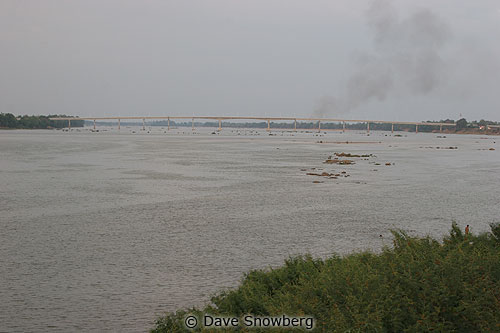
Oh man, the minute we walked out this morning we felt the heat building. Not a cloud in the sky! Oof. We set out to see if we could get across that bridge. We rode along the river to the base of the bridge, then back along it to where we could push through a break in the guard rail. We saw a couple of people on motos approaching the road block, and a moto coming across from the other side of the bridge. So! We rode up and, waiting only a second for a moto driver to push his scooter under the bar across the road, we did the same. Then we hopped on and rode across like we did this every day. No “present” necessary.

The land emptied out again, and soon it was just us and the water buffalos, only they were smart enough to cool off in the muddy ponds.

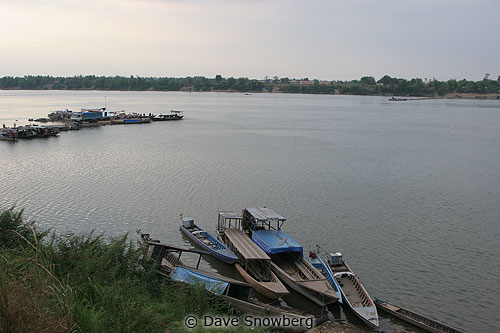
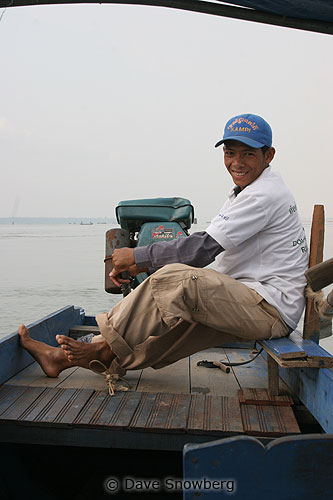
As we got close to the turn-off for Don Khong, one of the islands in the middle of the Mekong, we wondered how we’d know which road to take. Finally, we saw a sign to turn off for Don Khong. We rode through a small village to the end of the road at the edge of the river. A couple of young men, boys really, came out to greet us and asked us if we wanted to go across. We said yes, and asked how much. Four dollars, he said. We didn’t have any Lao Kip yet, but we knew that the dollar was also used in Laos, as well as Thai Baht. Dave thought $4 was too much, so we bought a couple of sodas and sat down in the shade to see if anyone else came along. Finally, we figured if we wanted to get over there we might as well pay the price, so we did. The ride took less than five minutes, and we were dropped right where the guest houses and restaurants are.

While I was looking at a guest house recommended in the Lonely Planet book (Pon’s) Dave talked with the woman next door, who said she had rooms for ten dollars. I wasn’t thrilled with the $12 room at Pon’s, so I looked at the woman’s $10 a/c room and it was perfect, an upstairs end room with windows on three sides. We wanted to stay a rest day here, and this was a comfortable choice. Plus, the woman running it was sweet and so smiling, and she helped us with learning the Laos greeting, saying thank you, and things like that.

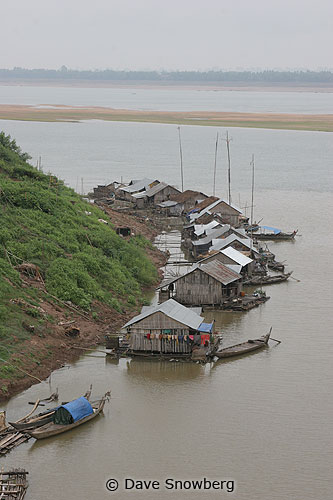
After getting settled and showering, we sat on the river’s edge deck of our guest house and had banana shakes while watching the sunset reflect on the clouds.

A note on money: if you don’t yet have Kip, try to use Thai Baht rather than U.S. dollars, since their rate is much better for Baht. The local exchange for figuring prices in dollars is 8,000 Kip per dollar, but currently you should get a rate of at least 8,500 at a bank, or about 8,750 through an ATM. Whether using dollars or Baht, you will get Kip in return for everything but the guest house bill.
Kratie to Steung Treng, Cambodia

145 km

We left before six a.m. and found the sky was mostly cloudy and the air was cool. This was a real blessing since we were looking at a 140-or-so kilometer day. There are no real towns and no guest houses between Kratie and Steung Treng, so we made sure we had enough food and water to carry us through a very long day.

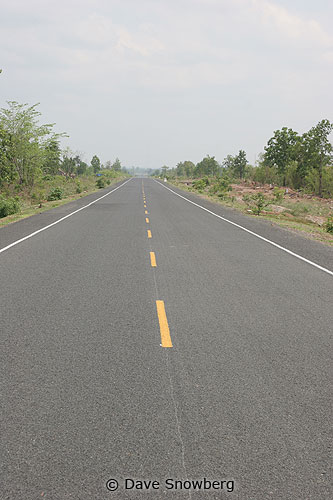
We enjoyed the cool morning as we rode north past the place where we saw the dolphins yesterday. Soon after, the village lining the road thinned out and after a while we found ourselves to be the only people on the road for good stretches at a time. We haven’t seen much empty land in Southeast Asia. We heard that they’ve recently cleared the land near the road of land mines and from here to the border the government is now starting to let people move in to farm. I wouldn’t want to be the first farmer.

img_7029.jpg

By mid-morning we pretty much had the road and countryside to ourselves. We passed through very small villages now and then, waving a few hellos to the shouting children. Some of them don’t know hello, but instead shout, “OK!” really loud. Many others shout, “Bye bye!” and answer hello only if we say it. Here’s another thing we’ve noticed since that first muddy day along the Mekong: there are groups of kids every so often who shout hello while holding their finger in front of their lips like a “shh” motion. I don’t know where these kids got that one. I mean, we came up with some theories, one being that someone got a bit overwhelmed by the many many repeated shouts of hello all through the village and replied by saying, “Shh” and holding up their finger. Who knows. They’re so cute they make me laugh out loud sometimes. They get so tickled when we say hi back that sometimes they scrunch up their shoulders, laugh uncontrollably and run away. They’re really the cutest ever.

Steung Treng is at the junction of a major river which joins the Mekong. So, to continue tomorrow we will need to either take a very short boat ride for FIVE DOLLARS EACH (grumble, grumble) or try and see if we can sneak across the newly-finished but not-yet-open bridge. The proprietor of the restaurant we ate dinner at said to bring a nice present for the guys and they might let us pass. Ah, yes, a “present,” of course.

Five Dollar Ferry

Five Dollar Ferry

Free Closed Bridge

Closed Bridge

Kratie, Day Two

32 km

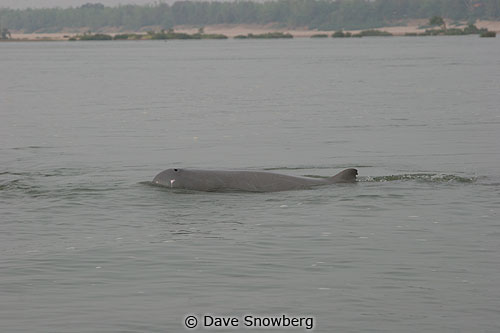
We rode a few kilometers north of town to see if we could get a view of the Irriwaddy dolphins, the endangered freshwater dolphins that inhabit the Mekong in this area. There are only about 80 dolphins left, and this is supposed to be the best spot to see them.

We got to the viewing area and read the brochure on the boat rides. We’d already heard from another cycling couple that the boat ride is good and they don’t seem to try to get too close and there are not too many people out there at any given time. Some of the money goes toward their preservation, and it also shows the local people that the dolphins are valuable for saving, since they bring in tourist money to the area. So we went ahead with the ride, $14 for both of us.

It was a wonderful time, and we saw many dolphins, or at least a few dolphins many times. The boat driver would get us to an area and then cut the motor and paddle us around. When we floated too far away, he’d motor us back to the good spots and do it again. We got some great views. These dolphins don’t jump out of the water, but they do come up for air. They’re very shy, but we did see and hear them and it was really a special thing to see.

Chlong to Kratie (Pronounced Krah-cheh or Krah-chess locally)

38 km

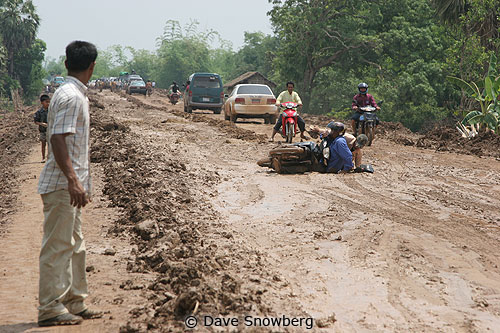
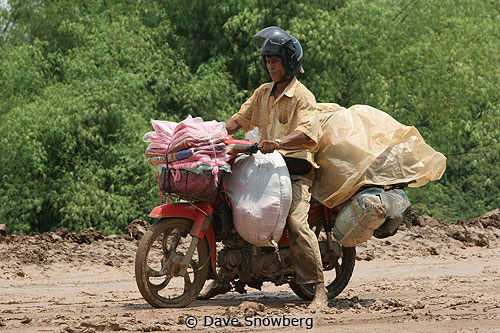
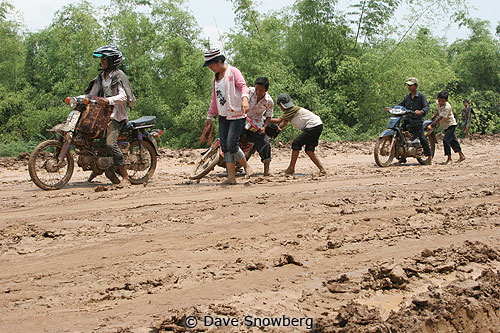
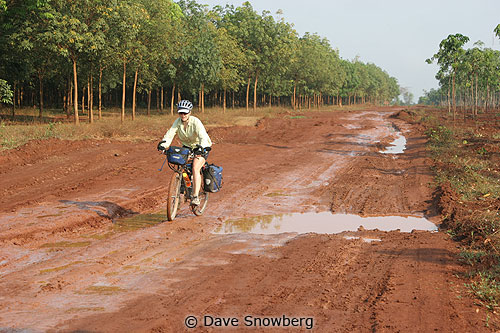
We expected today to be short and easy, with only about 30 km to ride. It was raining when we woke up, and by the time we got out of the hotel it was only sprinkling. A Cambodian driving the other way said he went through road construction much of the way from Kratie to Chlong the day before and he thought it would be a bit difficult. We rode about four kilometers out of town and saw the beginning of the road construction: a very wet, muddy clay coated the surface and most people were stopped to consider the odds of making it through. A major portion of traffic in Cambodia is motos, and there were a few trying to get through. Normally we see anywhere from one to five people on one motorbike, and most moto passengers were walking, barefoot, through the mud behind struggling drivers. Many a scooter went down, and there was a huge crowd of locals watching the spectacle. Some attacked with speed, others on bare tip-toes keeping the bike upright while barely inching forward. The sprinkle became a full rain again, so we turned around to wait it out in a restaurant.

The view from the restaurant where we waited out the rain.

Three hours later we returned to see even more traffic and people backed up, but more were also making their way through now. The sun had come out and so we waited, while watching, another hour and a half or so before going through.

The spectacle of the mud race!

Within a couple of hours we were going through dust. We made it to Kratie in the late afternoon, with the sun showing it’s full power, the cool rains a very distant memory.

Kampong Cham to Chlong, Cambodia

99 km

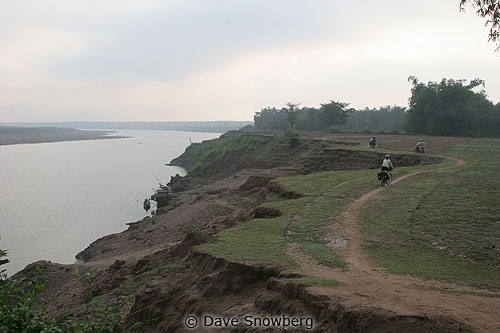
Goodbye horns, hello dirt! We thought we left the noise behind yesterday, but today we really enjoyed a lack of traffic. We took the “river road” north from Kampong Cham on the east side of the Mekong. It started out as a hard-packed gravel and dirt road much like the urban trails in Flagstaff. Soon it turned to hard-packed and rough dirt, and soon it became mud because of the rains that came through early this morning. We went from dirt to mud and back to dirt several times. A few times, we left the main river road to follow single-track paths behind the villages right on the river’s edge, winding between the river and fields of corn and tobacco. It was my favorite day in Cambodia because the scenery was green and beautiful, the pace was slow and the people were the most warm and welcoming of any we’ve seen here so far.

We rode right on the edge of the Mekong for many kilometers before heading inland on a dirt road.

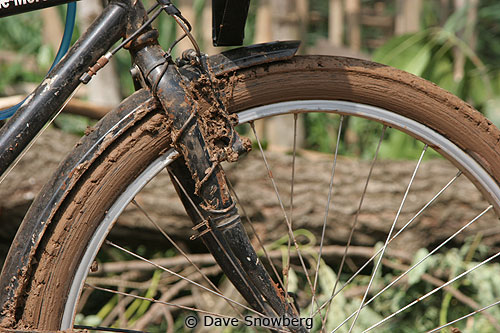
Later, the mud just starts to build up as we ride and push our way through ox-cart village roads.

The day was longer than we expected from reading our map, and it was our longest on this trip in terms of time. The rough dirt and muddy sections took a lot of time and effort. Luckily, the last 25 kilometers were paved with chip-seal so we were able to increase our speed for the last bit. We were completely tired out when we finally reached Chlong.

Kampong Thnor to Kampong Cham, Cambodia

80 km

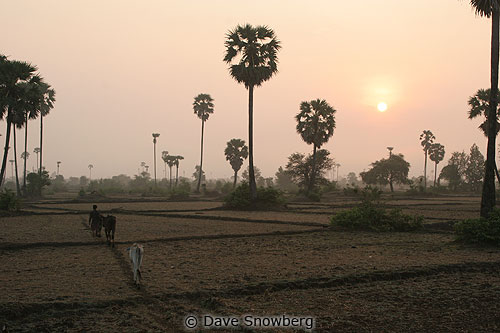
We see countless farms each day, but we’ve seen only a handful of motorized tractors working the land. Instead, more and more, we see large white cattle hooked up to ox carts and plows. If they’re not working, they’re usually tied by a rope through a ring on their nose to a stake in the ground where they munch on any remaining green they can find. Other times we see them moved, two at a time, by a lean man encouraging their pace with a light tap of the whip from behind, holding their ropes like leashes. These are the tamest cows I’ve seen.

A farmer leads his cows out to the fields in the early morning mist.

Today the road goes from pavement, to dirt, to mud, and back to pavement again. It rained this morning, and we are on a lesser road now, so we are prepared to see anything. But as we choose smaller, less maintained roads, we also see less traffic and that is a relief.

What is not a relief is the constant frustration of knowing we are being charged a special “tourist price” for many things here in Cambodia. We can sometimes see that we’re being charged more than other people, other times we just know it because we might have paid half the price for the same thing earlier in the day (like a simple can of Coke or a bottle of tea). It can happen in restaurants, fruit stands and markets, and probably sometimes at hotels although it’s harder to know. We understand that Cambodia is coming through the other side of a long tragedy and that tourism is a great infusion of money into their economy. But does it have to be infused so quickly and so much by us? We are spending more per day here than we spent per day in Malaysia and Thailand. Guidebooks tell us we have to bargain for everything, but so far we have found no one willing to bargain except for a woman who was selling us warm cans of soda and the illegally-copied guide book I bought from a young girl at Angkor Wat. (“This is a copy,” I said. “Yes,” she said, “but it is a good one.”)

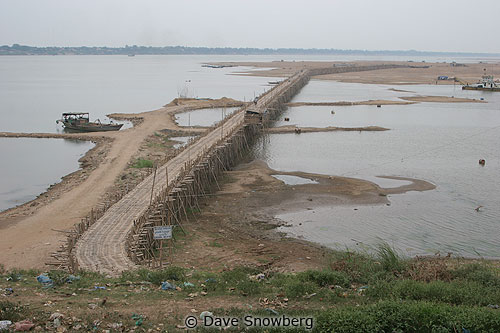
Tonight we rode across a hand-made bamboo bridge to an island in the middle of the Mekong river. Once we got to the other side we saw it was a toll-bridge. That’s fine, we thought, it’s a pretty neat thing to see. We rode up to pay our way, and saw two people on a moto pay 1/4 of what we each were charged. Each of these incidents are small examples, but when you consider how many times we stop and spend money every day, it adds up. Where do we draw the line? We want to see Cambodia rebuild and prosper. When we’re bugged enough we just walk away. But we have to eat. And we are glad to be seeing the things we’re seeing.

This handmade bamboo bridge, re-built every year for the dry season, leads out to an island where people live and farm. Even a car came down this thing while we were riding on it! We had to balance on the edge and I nearly got my toe run over.

Stoung to Kampong Thnor, Cambodia

89 km

The road was not quite as smooth today but still paved and in great condition. We’re very happy to find that dogs are no problem here in Cambodia. There are so many people moving around by bicycle that dogs pay no attention to us, we are just part of the human river flowing through their territory.

We sailed along at an enjoyable pace through what felt like one long village, broken only now and then by larger fields or towns. Simple wooden houses that were elevated on wood or concrete posts lined each side of the road for miles and miles, with children playing and people working in the shade underneath. At nearly every house there were a few children shouting hello and waving furiously. Mango, Durian, banana, and coconut trees shaded many of the yards. Cows wandered through empty fields, eating the remnant stubs of last season’s crops and depositing manure that will add to the next. Chickens scratched and pecked and ran willy-nilly across the road. It’s rural Cambodia that delivers the joy of bike touring again after our time in Bangkok and Siem Reap.

Siem Reap to Stoung, Cambodia

101 km

We’re out of the hotel just after sunrise, and though it felt warm and sticky when we were loading the panniers onto the bikes, the breeze felt cool once we started cycling.

We made our way through the morning bustle of traffic, which was already at full speed by 6:00 a.m. and backing up near the roadside markets just outside of town. This is the land of horns, with every motorized vehicle adding to the cacophony. Small cars will sometimes have horns that belong on Mack trucks, some motos (scooters and motorcycles) will have car horns, and vans or other “people-movers” may sound horns that in the U.S. announce ambulances or fire trucks. And the flow of traffic, if you can call it that, is a might-is-right anarchy, with speed or size dictating who gets to go where and in what order.

In other words, it’s crazier than anything we’ve seen in any other country, and Dave has ridden in Central and South America. We saw it the minute we crossed the border into Cambodia, and we’re likely to see it until we leave. There are no traffic police, as we read in a German-published atlas, but there are spray-paint outlines of accidents scattered here and there on the roads. Not that we need reminders to be careful.

Not only is the road paved today, but it is smooth and flat and we make great time. We also see a slightly greener landscape, with farms outlined by palm trees stretching between the many small villages we cycle through. A few fields are in use, but most are waiting for the rainy season to begin. We see clouds building in the distance, but the heat is still continuing to build. There is rain forecast for the area over the next few days.

Billboards like this line the road.

Siem Reap, Cambodia, Day Four

32 km

Today we first visited Banteay Kdei, built in the late 12th or early 13th century. This site has many similarities with and is considered a smaller version of Ta Prohm and Preah Khan. It was built by the same king, Jayavarman VII, who built the most cities, temples and monuments of any of the Khmer kings.

We decided to visit Ta Prohm again, because it is closest to how it would have looked a hundred years ago, and had many more wild corners for us to explore. We did discover, though, that they are doing a bit of archaeological digging and restoration to shore up some of the walls, but not much. On the way out, we saw one of the groups of traditional Khmer musicians playing music by the side of the path. They are usually mostly land-mine victims and make money by selling CDs and taking donations. We placed some money in their brass bowl and enjoyed the music. I was happy to see that then a few other tourists stopped taking video long enough to do the same, I was hoping they wouldn’t be pointing cameras at these men so long without doing so. One woman plopped herself down on the small platform, nearly landing on the lap of one musician, and sat there yapping at her friends about how to get a good picture. We cringed and moved on.

Our last stop was the huge area of the Royal Palace Group inside Angkor Thom. We saw the long and imposing Elephant Terrace, which ends near the Leper King Terrace. Behind them was the Royal Palace, which was used by several successive kings.

Moving toward Laos

We are now in the habit of getting up at about 4:30, soon maybe 4:00, so we can cycle in the early morning and hopefully finish for the day by noon or 1:00. Tomorrow we leave Siem Reap to head East, and in several days we will be in Laos. We may be off the radar for some time, but don’t worry. I’ll have way too much writing to post when we get back online!

« Newer Posts - Older Posts »