Category Archive for: 2008 SE Asia Bike Tour

Na Kay to Lak Sao, Laos (The Loop, Day 2)

76 km

It rained last night, so today started out very cool and the air smelled like a floral forest. We enjoyed a long cool morning while we cycled about 40 km on nice, packed dirt and gravel. The road surface looked like it’s been prepared for eventual paving. The newest of the many dams in this mountainous area has just been finished and the large reservoir will be filled by the end of this coming rainy season. They will allow recreation and water sports on the reservoir, and our host at the restaurant last night told us he expects the tourism in the area to really grow. I’m glad we’re riding this road while it’s still very quiet and not yet paved. This is some of my favorite riding on this tour because the mountains are lush and green and rugged and it smells so fresh and green.

At about 40 km the road narrowed and became steeper. This part of the road was even quieter and wilder, with the forest closing in around us, offering shade and the sound of thousands of whirring and buzzing insects. I have a smile plastered on my face, it is just too much fun.

Near 60 km the road passed through a couple of small villages, then widened as it dropped down to a flatter valley. It stayed quite rough all the way to Lak Sao. Coming down into the busyness and dust was like coming out of a dream. We found a room at the Souriya Hotel on the third floor with a beautiful view of the mountains along the road we’ll follow tomorrow. We spent the afternoon hiding from the heat in our a/c room watching movies on satellite TV. We’re much like my beloved Shasta dog these days: either running hard or flopped out on the floor.

Thakhek to Na Kay, Laos (The Loop, Day 1)

79 km

We first heard about “The Loop” from Hans, who gave us his copy of Lonely Planet Laos, and between his description and the book’s, it sounded like something we had to add to our trip. Instead of continuing north on highway 13, the main north-south highway to Vientiane, we will add probably three days of riding first east on highway 12, then north on 8B, and then take route 8 west back to highway 13. Some people continue from there back down to Thakhek making the full loop, but if you don’t have to rent a moto and have your own transportation, you can just continue on to Vientiane, which is what we will do.

This loop gets into pretty remote, non-touristy and rugged areas of Khammuan and Bolikhamsai provinces, very close to Vietnam. It climbs 600 meters and gets into mountain highlands that should be a bit cooler and pretty wild in places. The Thakhek Travel Lodge, where we’ve been staying, has a very helpful book where travelers write descriptions of their experiences with The Loop, though most people ride it on motos, not bicycles.

The first 45 kilometers were on a pretty new chip-seal road surface. We expected to be climbing, but the grade of the road was so gradual we hardly knew we were gaining elevation at all. At about 45 km the surface turned to packed dirt and gravel, but still a pretty smooth road. Then at about 65 km the surface degraded to a very rough and loose rocky road. Then it became very steep and narrower at 71 km for a climb up to the plateau.

By the time we got to the really steep climb it was nearing noon and very hot. There were no trees shading the road and it was very dusty every time a vehicle came by. I think I’ve mentioned the heat here. Well, this was just too much for me. Without riding fast enough to get a breeze, I just couldn’t handle the heat while climbing a hard hill. I was feeling light-headed and nauseous. So when we saw one chance for shade, we took it.

We ended up sitting there for a couple of hours, resting and reading and waiting for my stomach to calm down. Finally, a breeze started working up and we set off to finish the climb. at about 78 km the road topped out and we were in our night’s destination, Na Kay. Taking a right at the police box, we immediately found a basic guest house on the left. A woman we met there cooks at a restaurant about a kilometer down the road, so she waited for us to shower and then she walked us there. This was a great restaurant, with a nice raised wood deck with a great view, and the food was wonderful. The sign over the entrance says Mitthaphab Restaurant, but the menu says Friendship Restaurant. The woman’s brother, who recently built the restaurant, spoke very good English and we enjoyed talking with him. Then he drew us a very helpful map of our ride for tomorrow, showing us where to avoid road construction and where the road will turn difficult. He was apprehensive about us riding it on bicycles, and we tried to reassure him we would be fine. We all enjoyed watching the clouds build up in the distance while the sun set.

Thakhek, Laos, Day Two

14 km

We took another rest day today because yesterday was extra long and hot and we have some rough and steep roads ahead of us. So today we did some shopping for provisions, some writing and internet, and of course, during the cycling to and from these activities we got soaked with water (good!) and bombed with more dye (not good!). We will be glad when the Lao New Year is over, as will many of the locals. Two nights in a row the guest house’s cook was late because she was busy dodging dye and water while going to the market for supplies and getting to work. Everyone gets around by motorbike (moto) here, and it must be hard to get anywhere during this three-day new year.

When our shopping was done we hurried back to our huge, beautiful, comfy, air-conditioned room and watched a movie on satellite TV. All this luxury in a $13/night hideout.

Savannakhet to Thakhek, Laos

130 km

It was a long day, but it was made a little easier by the cool morning. We were also doused early and often as we passed through village after village where kids had their buckets and hoses at the ready. I thing they got an extra kick out of cooling us off. But as the day went on we found ourselves dodging home-made water balloons: small plastic bags filled with dye-colored water tied off with rubber bands. So when we saw kids or teenagers with bright red, yellow, or blue hands we knew we had to dodge their dye bombs. We each have only one long-sleeved shirt now to ride in since we left all extra clothes in storage in Bangkok. We kept seeing people on motos riding by with nice jackets and other clothes completely bombed with dye.

What a shame this element is part of the water festivities, because it was not fun. We were both lucky for much of the day, but in the afternoon truckloads of teenagers started passing us on the road and they had perfect, slow-moving cyclists as targets. I continued to somehow get lucky, but Dave took a few bombs. By the time we finally got through this long day we were so tired of dodging groups of teenagers that we were getting pretty grouchy. It took us over eight hours from door to door today, and we were ready to be off the road and away from the Lao New Year Celebrations. Good thing our guest house is quiet and secluded a bit, and serves food in its own restaurant.

Savannakhet, Day Two, Laos

Happy Lao New Year! We got up at our usual time and ate fruit and yogurt that we bought the night before and lounged in our a/c room watching a movie. What luxury!

Later we went out to find more snacks to pack on our bikes for the days ahead: the usual nuts, salty crunchy snacks, baguettes, and the elusive Nutella or peanut butter. We usually buy fresh fruit along the way, and eat lunch and dinner when we arrive at our destination. The town was quiet and slowly shuffling arounds when we found an internet cafe and spent a bit of time emailing. But when we came out we found that people were setting up hoses and buckets on the sidewalks in front of their homes or businesses and people were slowly gathering with a festive excitement building. As people on motos went by, some were throwing water on them and laughing. It was beginning! Dave took a couple of pictures from a distance, but quickly found that having electronics in this atmosphere was simply not going to work. We walked back to the guest house to deposit the camera and got our bikes.

When we came back there were even more people gathering, and in that amount of time there were twice the number of places with buckets, hoses and people gathered. Water was flying everywhere and cheers were going up all down the main street. We watched for a short while, then decided to cruise our bikes down main street and participate. It was already getting pretty hot and that water looked cool.

It took not time at all before we were completely soaked. Before hitting the end of the main street we were soaked five times over, head to toe, and it seemed to really please the locals to douse a couple of foreigners on bikes. Some of them would motion for us to slow down so they could pour a small bucket down our backs, others simply threw bucketfuls at us, while some were developing good aim with super-soaker water guns. Everyone was laughing, music was playing from huge speakers out of businesses along each block, people were dancing, and everyone was soaked. There were pickups filled in the back with people who were inviting water to be thrown and who were also throwing water from huge buckets. Motos were packed with people cruising up and down the long street back and forth. After a while the street seemed to clear a bit, and a parade led by a truck with a big Buddha statue came by, preceded by kids playing drums and followed by groups of people in traditional costumes. After the parade went by the water started flying again. We spent the afternoon getting soaked, and when we were cruising on our bikes we got invited to stay with one group of locals and participate in the water throwing. After a while we wandered back to the Seven Restaurant, where other Westerners had a hose and buckets out front, and we got in on the action there as well. It was hilariously fun. The party went on long after we left, but we had to get our dinner and showers and wash clothes so they could dry overnight and get packed up so we could leave early in the morning. Bike touring in a hot climate does not encourage late-night partying. We were in bed at 8:00, listening to the sounds of the sky opening up and rain pouring down hard. It’s a good sound, and we knew it would be a cooler morning.

Ban Paksan to Savannakhet, Laos

83 km

Today’s ride seemed much longer than it was, and when we arrived my thighs were completely fatigued. The long, hot days have been taking their toll on me, and I was in need of a rest day again already. So, we pulled into Savannakhet looking for a guest house where we’d like to spend a couple of nights. We found the Nonsoda Guest House right on the Mekong river and took an a/c room without looking any further. Ah! We took our lovely cold showers and cooled off in front of the a/c while catching up on a little news on CNN International. Then we went out and cruised the main street and found the Restaurant Seven, a neat and friendly place with afternoon shade and ceiling fans that create a relaxing place to eat lunch and watch the local busyness out on the street.

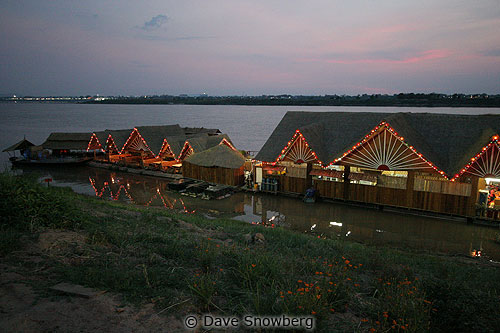
In the evening we chose a large and new-looking bamboo restaurant that floats right on the Mekong with a perfect view of an island in the river and Thailand on the other side. This is a fairly busy border crossing town, and we could also see the bridge that connects Laos to Thailand just on the north side of town. As we ate we enjoyed a fiery red sunset and soon felt cool breezes off the water.

img_7103.jpg

Khong Sedon to Ban Paksan, Laos

102 km

The advice we got from the cyclists yesterday really helped for today. We knew where to expect a guest house, otherwise we might have spent much of the ride worrying about where we could stop. There is no guest house for 100 km from Khong Sedon, and we stopped at the second one we saw. We were still 3 km from Ban Paksan, though we didn’t know how far it was at the time. We were just hot and tired and ready for a room. The owner was smiling and welcoming us to his new, five-day-old business. He even said his daughter could drive us into town to a restaurant so we wouldn’t have to ride in the heat. We settled into our room and took that most-inviting cold shower that we so look forward to every day.

Later, we took the owner’s daughter up on the offer for a ride into town–not only because it was still hot at 5:00, but also because we could use the help finding a good place to eat. We’re so glad we did, because we got to spend time talking with Koung, a 21-year-old Lao girl who was really sweet and open and who gave us a different perspective on the Lao culture. Koung spent three years in Vientiane at university studying English, among other things, but prefers to be back home in her small town of Ban Paksan where her friends and family are. She’ll probably continue to help her father with his guest house, but other than that we got no clues of her goals or aspirations. She’s got a busy social life, though, and she made plans with her friends at the next table to go to a “night club” later–this means a karaoke bar, which usually takes the form of a small, dark, concrete building with speakers made for a room three times the size. We were invited, but we declined, seeing as we go to bed at the geriatric time of 8:00.

Koung’s nickname means shrimp, which we had on top of our vegetable fried rice for dinner. Koung said Laos is gearing up for the Lao New Year in two days, a three-day celebration much like the Thai New Year during the same time, when everyone throws water on everyone else, drinks lots of Beer Lao, and goes to the temple to pray to Buddha. We had already had water thrown at us by some kids the day before. We were told to get ready for more.

Pakse to Khong Sedon, Laos

73 km

It’s just hot these days. Right from the start of each day. We are here in the absolute hottest time of the year. Maybe not the best planning, but it is still worthwhile. Somehow our bodies are adapting, and as long as we start really early we are still able to get in some pretty full riding days. The last couple of days we’ve had some tailwinds, which speeds us up by a couple of km per hour and that’s helpful. As long as we are moving on our bikes we feel OK, but the instant we stop for any reason–to eat, find a bush or take a picture–we feel completely overwhelmed by the heat. And there is no stopping unless it’s in the shade. There are some great photo opportunities passing us by because it is just too darn hot to stop.

A brief morning stretch. I was unaware of the monks walking by on their way to collect food from villagers.

We had a really hard time finding lunch. This is sort of a desolate town with few restaurants, at least obvious during the day. We approached one where a woman was sweeping the empty front area. We asked if she had food and got sort of a blank stare. We asked if we could eat and what she had, and she said “Soup!” without a smile and without making a move or asking if we wanted any. She was giving us nothing, so we smiled and said thanks and moved on. We circled around and around and finally found another place. This place only served papaya salad, but they also had a fridge with yogurt, so we had some of that too. Then the woman called a friend who came and said she has a restaurant where we could eat dinner just down the road. She asked what we liked to eat, we explained our vegetarian preference, and she said she’d cook a meal for us without meat. Great!

After spending the hottest part of the afternoon in our a/c room reading and journaling, we went back out for dinner. When we arrived we were greeted with smiles and shown a table. Soon after we were served a huge platter of stir-fried vegetables, rice, some salsa-like sauce, and som tam, a fragrant and delicious fish soup with lemon-grass and mushrooms with vegetables. It was all spectacular. While we ate we talked with our hostess, Latdavanh. Everyone here is given a nickname by their parents when they’re babies in order to fool evil spirits. Latdavanh’s nickname is Terb, which means fluttering eyelids. When she was a baby, Terb’s eyelids were always fluttering in her sleep. Terb is a pharmacist and her parents are both doctors. They all work at the hospital in town. Terb also works in her sister’s restaurant to help out. In her spare time, Koung is studying English. But the only book she has is “English for Hospitality Workers,” which is simply a very long list of sentences in Lao with the English translation below each, and sometimes not a very good translation. There is no grammar, not even simple building blocks, and she has no dictionary. Despite this, she speaks really well, and we had a great time visiting with her and learning about her family, town, and culture.

Kingfisher Lodge to Pakse, Laos

60 km

We met two cyclists traveling separately at a roadside cafe this morning–one from Switzerland and another from Australia. They were headed in the opposite direction, and we got some great advice about choices we have coming up in Laos. We also traded our Cambodia map for a very useful Lonely Planet Laos guide. It has much more info than our LP SE Asia book.

Another hot and steamy morning.

We got to Paxse feeling hot and wilted, but we cheered up when we saw an Indian restaurant and refueled. We then got a huge a/c room at the Great Wall Hotel for $15 and cheered up even more after a cold shower. We had a restful and uneventful evening.

Don Khong to Kingfisher Eco-lodge, Laos

102 km

While Dave rode around the island yesterday, he found where the real ferry dock is: only 3 km south of the area where the guest houses are. Last night we asked a local how much the ferry cost, and he said 5,000 Kip (about 60 cents). So we were each ready with a 5,000 bill when we got on the ferry, which had a wood platform on top of three canoe-type boats with a motor on the back. It was big enough for a couple of scooters, our two bikes, and four people plus the boatman. When we got off, we handed the boatman our Kip and he smiled and said thank you in Lao (korp jai). Easy enough, with no special tourist price!

As we turned back onto the highway, we noted the sign for the turn-off so you can have your choice of boats if you’re heading to Don Khong too: it is not signed for Don Khong, but instead says, “Ban Hart, Ban Khinak” and you’ll want to follow the paved road straight toward Ban Khinak. It might make most sense using the ferry on the way to the island if you’re heading north, and use the longtails back to mainland, because riding to the ferry and back to the turn-off for the longtails was an extra 9 km this morning.

We had heard about the Kingfisher Eco-lodge from Damian and Judy back in Krabi, Thailand. We had dinner with them one night and got all kinds of great information about our ride in Laos, and we were looking forward to a “very romantic” rest day at the Kingfisher. Dave made reservations for two nights through their website a few days ago. From our guest house on Don Khong, it was 91 km to the turn-off to Kingfisher Lodge. There is a sign at the turn-off to the right, which directed us up a smooth gravel road. It was a very hot day, and as we slowed down climbing a bit uphill, we remembered their words telling us it was worth it. And it was. The place is just past a small village and is on the edge of a lush green wetland. The grounds are beautifully landscaped with palms, banana trees, and other greenery to offer shade.

Unfortunately, they did not have our reservation, and they were booked tomorrow night. We decided to go ahead with one night. We stayed in an “eco-room” for U.S. $16/night, which was like a duplex bungalow with separate shared bathroom. All bungalows plus the main restaurant/reception building look out over the wetland, which often has water buffalo roaming through, and in the evenings the locals let the elephants loose to eat and sleep out there.

Speaking of elephants: we rode one. The lodge said it’s a good way for the village people to make money with the elephants instead of using them for logging. At 3:30 we walked back to the village where the rides begin, climbed a platform and sat on a cushioned seat on top of one very large elephant. The elephant driver sat in front of us on the elephant’s neck and used his feet to tap her ears and grunted commands to make her go. Then we walked through the village and followed a gravel road up a very steep hill. But! Three-quarters of the way up that hill we met two elephants with people coming down. It was late in the day, and I think our elephant was hot and tired and wanted to go back with her friends. After the two elephants passed us, she turned right around and started following them.

Other elephant riders.

Our elephant driver would have none of that. He knocked her on the head with the wood end of his little rope stick and yelled a command. That didn’t work. Meanwhile, elephant sort of ran downhill, with us bobbing around on her back.

The driver turned around and traded his little rope-stick for a metal hook. It looked like a meat hook. He took it and jabbed it into her forehead and yelled again, trying to turn her head to the side. This time she raised her head and trunk and trumpeted, again and again. Turning her head each time he jabbed her with the hook, she would then turn back, trumpet, and run forward. I wanted OFF. The driver kept looking back at us with a smile saying “It OK, it OK. Want go back.” and then hooking her again. I said, “It’s OK to go back, it’s OK to go back!”

The other elephant drivers finally stopped their elephants and one of them was shouting in Lao at our driver. Was he yelling at him for hooking the elephant? Or was he yelling about what to do? We’ll never know. When the other elephants stopped, so did ours. After a minute the others went on, and our driver kept our elephant at a stop. But when he tried turning her back around she got mad again and trumpeted a couple more times before finally turning around and going up the rest of the hill.

When we got to the top there was another platform with stairs. The elephant went right up to the platform and we got off. My legs were shaking while walking down the stairs. The driver pointed up to where a ruin was, and we walked up to take a look.

I did not want to get back on that elephant, but the driver was waiting when we got back and the elephant looked calm. Dave said maybe I’d feel better if I pet the elephant, so I did. I’m not sure how much better I felt, but I was glad to see that the elephant stayed calm as we got back on, and made good time getting back to the village.

Back at the village, we got off and immediately were met by a girl who had bananas to sell for the elephant. I bought a big bunch, and started peeling one for her. They said no, and motioned to give the elephant the whole bunch. She took the whole thing with her trunk and stuffed it in her mouth, chomped a bit and then spit some back out her trunk all over her body.

I’m done riding elephants. I don’t want to be the reason some poor animal is forced up a hill in the heat or hooked in the head for wanting to go home. I just felt bad about the whole thing. I don’t propose any better solution for the retired logging elephants, but I sure hope the tourist business of riding elephants isn’t causing them to go out and get more of them from the wild. I wish I could see them roaming out in the wetland instead.
« Newer Posts - Older Posts »